
Why I Hate Spring
My Battle with Lesser Celandine

It’s finally Spring in the Greater New York area, and most people are deliriously happy to be prepping flower beds, seeding lawns, planting flowers, and firing up the grill in anticipation of those vegetables they will grow.
But for me, the first breath of Spring comes with a groan. Starting in March, the first leaves of invasive Lesser Celandine plants start sprouting at my house. Then, as the temperature warms, the buds blossom into a bright shiny yellow flowers. Pretty right?
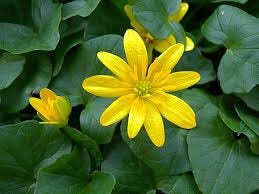
Wrong! These invasive plants reproduce like wildfire year after year and can’t be contained if left to enact their evil plans to take over the world.
If you have one plant, it will multiply the following year.
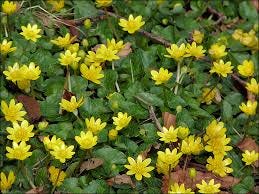
Three or four years later, it will expand, crowding out and destroying any ground cover you may have planted. Say goodbye to your English ivy, pachysandra, and myrtle. Every year you will lose more and more of it as the Lesser Celandine takes over.
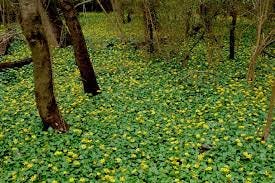
So, every Spring, my writing time is interrupted, so that my husband, Rob and I can dig it out by hand or spray it in the areas that do not have other plants. It takes hours, days, weeks to pull this alien invader from our yard and wooded areas. And before we can get it all out, around the end of June it yellows and simply disappears, secretly plotting its expanded reappearance the following March. You think I’m exaggerating, but I’m not.
Our neighbors didn’t heed my warnings about this destructive plant. For them, it’s already a losing battle. Thousands of dollars’ worth of pachysandra has been overrun by Lesser Celandine. Then when it goes dormant, there is only empty dirt loaded with bulbous seeds lying underground in wait for next year.
That’s said, there are really only three solutions:
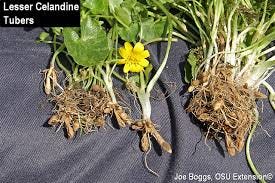
· Pull it out by hand together with the tubers, roots, and bulbils
· Treat it with glyphosate (but don’t get it on other plants you care about)
· Or Move
Watch this excellent video comparing 14 alternative treatments attempting to eradicate Lesser Celandine, including glyphosate (the winner), vinegar, plastic sheeting, mowing, torching, chelated iron, triclopyr, and other methods.
This is what the nasty roots look like:
So now my late afternoons are about weeding. This has replaced my daily walks and visits to the gym. It’s exercise to be sure, but it’s not the heart-healthy kind. And it breaks my heart knowing this feels like a losing battle. That said, if there is a bright spot, I did have an opportunity to rant about it in this post and warn you to keep on the lookout for this pernicious plant.
Last week I wrote about editing and weeding the unwanted stuff from your stories. “Kill your darlings,” I advised. Well, this is not one to vacillate over. If you see Lesser Celandine, just kill it. Otherwise, there is no happy ending.
***
Marilyn lives West Orange, NJ with her sweet, supportive husband, Rob Lieberman, and their support-cat, Miskit (short for Miss Kitty.) Their grown son, Matt, is making his own stories, sharing his heart, and rocking the world one day at a time.
If you don't do anything, what will they look like once the flowers fade?